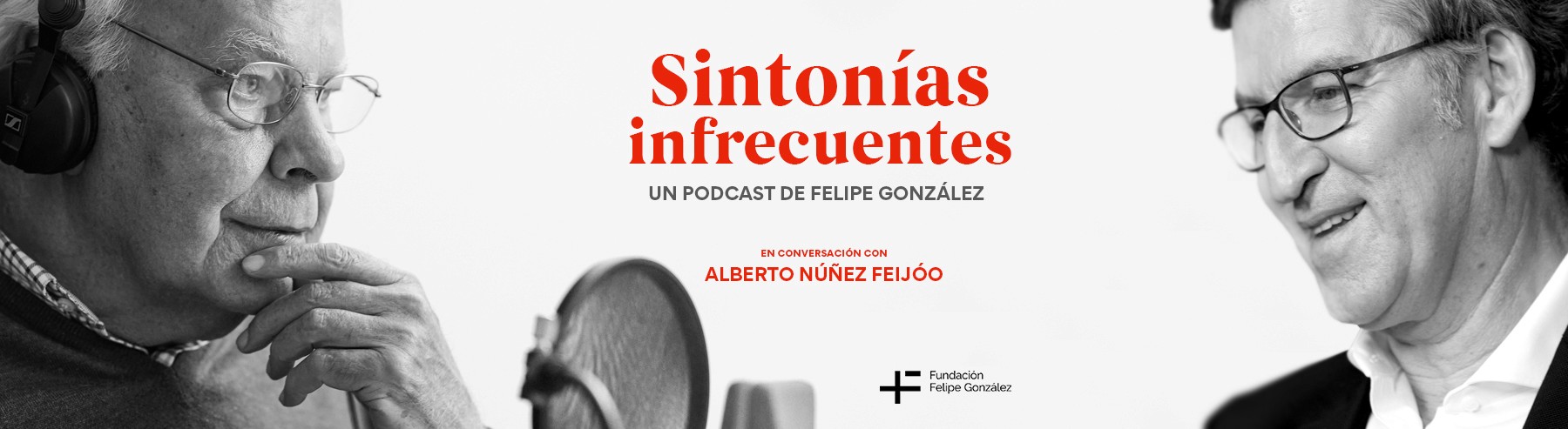
Felipe González, on the pardons, with Alberto Núñez Feijóo: "The conditions are not met"
Jun 14, 2021
After chatting with Ignacio Varela and Manuela Carmena, Felipe González shares for episode 3 of ‘Sintonías infrecuentes’ the presence of the current president of the Xunta de Galicia, Alberto Núñez Feijóo. They both embark on a dialogue about the need for agreements, the financing system, or the status of autonomies. They also address other current topics such as the pardons to the prisoners of the procés, the state of alarm, or the reform of the electoral law.
Listen to all episodes of Felipe González for free here
Felipe González began the conversation with Feijóo highlighting the challenging moment that Spain is facing, a situation that requires “great pacts like those of Moncloa,” referring to the agreements from the 77 transition, and has asked the president of the Xunta to identify those challenges to open up a dialogue that “I would wish for Spain and not only for us.”
“Problems must be faced from the center, not from the middle, which is a rare geometric point”
In this line of lacking dialogue, the president of the Xunta laments the scarcity of debates and the way “tweet politics has come to modify politics,” a point for which González has again recalled the figure of Joe Biden as an ally to end the 'tweet debate': “Biden does not wake up obsessed with the tweets he will make throughout the day,” he claims.
It is Feijóo who provides an example of this new political form: “In the investiture debate of Mariano Rajoy in 2016, the Podemos benches were tweeting all the time, no one was paying attention to what was being said.”
The pardons
Beyond the coronavirus pandemic, the economic rebound, or the progress of vaccination, the former socialist president wanted to focus the dialogue on other events “that will last longer,” such as the debate on pardons for those convicted in the procés. With this, Felipe González wanted to take advantage of the situation to clarify his opinion on ‘El Hormiguero’: “I have not said no to the pardons, I have said that the conditions for the pardons are not met, which is quite different, I am not vengeful,” he asserts.
“The government must decide on the pardons based on foundations, we have a problem of coexistence and a problem of territorial governance”
And González has emphasized that for the reunion or reconciliation to occur, the government of Catalunya must govern by respecting, even if they do not believe in them, the Constitution and the Statute, and he has assured he feels “fear” of entering a dynamic that the rest of Spain interprets as an anti-Catalan campaign. For his part, the president of the Xunta has taken up the challenge and has assured that not only are the conditions not met, but that there are none: “They have no interest in talking and raising matters normally.”
For his part, Feijóo concluded with a utopian reflection on the restitution of the Catalan seny and clarified that “the problem is that this is pardoning a parliamentary partner, which is Esquerra Republicana de Catalunya, to end a legislature.”
The financing of the autonomous communities
One of the most important points addressed in episode 3 of ‘Sintonías infrecuentes’, which you can listen to exclusively on Podimo, was the financing of the autonomous communities, a debate that the former president of the Xunta opened, affirming that the current financing system for the communities is the system that the Generalitat of Catalunya agreed upon with the Central Government: “This is not a criticism, it is a chronicle,” he asserts. “To say that the financing system of Spain's autonomies does not respect what Catalunya proposed is something I can say,” he concluded.
In this line, Felipe González agrees with his guest: “As far back as I can remember, the autonomous financing system has never developed without the disagreement of the Generalitat.”
“Not even the financing argument is an argument they can raise their voices with,” Feijóo asserts.
Felipe González believes there is a before and after in the Spain of the communities after the health and educational transfer: “The educational transfer was digestible, but the health one was not; it was a deficit transfer,” he mentions, concluding with a defense of the autonomous state against “the issues of little rationality from some political parties that were not relevant and now are.”
The Constitution
Both leaders agree on the Constitution as the main meeting point; Feijóo has also emphasized that those who oppose it “are the heirs of those who tried to frustrate it at the moment of its approval; what happens is that now they have power and before they did not.”
“The separatists are politicians who gather votes and have their ideologies, but Catalunya is much more,” Feijóo asserts.
Furthermore, González says that if he accepted that only the vote grants the right to break the rules of the game, we would have to accept the historical consequences we know as Hitler or Mussolini: “No one is condemned in Spain for their ideas; before reaching condemnation, there must be events that breach constitutional loyalty.”
The State of alarm
One of the hot debates in the current political and social landscape over the last few months has been the declaration and deactivation, with ups and downs, of the state of alarm. “The International Scientific Community has had time to make a vaccine, yet in Spain, we have not had time to make any law to manage the pandemic. It should make us reflect,” questions the president of the Xunta.
Both agree that there are decisions that must be made under the umbrella of the state of alarm, but the problem, they say, has arisen after its deactivation and the process of judicialization in the management of the pandemic. “I do not agree with the proposed replacement of the state of alarm, but I do agree with the intention,” González continues, assuring and reminding that to limit fundamental rights after the state of alarm, the alternative legislation must have the same normative rank as the state of alarm.
Additionally, both wanted to conclude the conversation by remembering a necessary reform of the electoral law. While González brought up the idea of opening the lists “to strike out those I do not want to vote for,” Feijóo focused on other aspects: “I want the mayor of my town, this to be the most voted candidate,” he concluded.