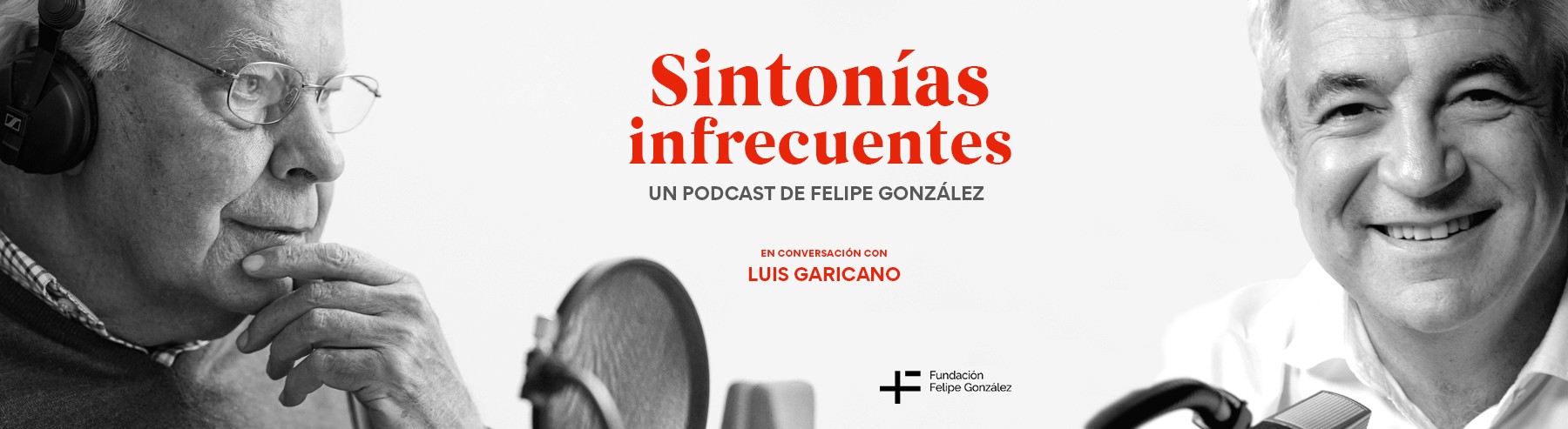
Vaccination in Spain and economic recovery, two of the keys to the new episode of Infrequent Harmonies
Jul 6, 2021
For episode 4 of ‘Infrequent Tunes’, Felipe González has the presence of economist, City Council Member of Citizens, and Vice President of the European Liberal Party Luis Garicano. He dialogues with him about, among other issues, the situation left by the coronavirus pandemic in Europe, the progress of vaccination in Spain, and the present and future economic recovery.
In addition, González and Garicano address other topics such as the labor future of young people, the problem of reversibility in reforms, or the new policy implemented by American President Joe Biden.
First of all, Felipe González wanted to thank the economist for accepting a “script-free” conversation, where the dialogue focuses “on the things that concern or relieve me,” he warns. A conversation in which he seeks to center the dialogue on the ‘European dimension of the pandemic’ taking advantage of the presence of the orange euro-deputy.
Advancing in the topics to be addressed, the former president of the Government initiated the dialogue by urging society to be cautious despite the significant progress of vaccination in Spain: “There will be a clear improvement, but we must not let our guard down,” he says.
“As long as the pandemic issue is not resolved, we have a threat; some aftershocks may surprise us.”
On the other hand, González referred to the difficult economic situation that he believes will have a “strong rebound”, an optimistic view shared by Garicano: “The purchase of vaccines by the European Union was the litmus test; if it had gone wrong, it would have been catastrophic,” he states. In this line, both have concurred on the cruising speed that vaccination in Europe has acquired, highlighting in recent weeks the role of Spain, “which is already doing it faster than the United Kingdom and the United States,” clarifies Garicano.
On another note, the euro-deputy lamented that the opportunity had not been seized, as in other crises, to bring about significant changes, an opinion that González shared, clarifying that “if the recovery does not introduce the necessary reforms to improve our competitive capacity, the underlying problems remain.”
The USA as an example
Taking advantage of the presence of Luis Garicano, Felipe González emphasized the importance of the European Union, which he says is “an extraordinary invention, but not a mechanism for resolving internal conflicts”, referring to the Catalan conflict: “Of course there are internal conflicts, but we must change our approach to go orderly to Europe.”
In this line, the euro-deputy pointed to the United States as the example of a territory that is overcoming a significant division thanks to a national program, instituted by Biden, that transcends identities: “Trump dedicated himself to making policies for groups and not for the whole of the United States,” he indicates, highlighting one of the main issues that current politics does not address: the resolution of the real problems of society.
The reversibility and reforms Both also share the opinion that Spain must take advantage of the current moment of crisis to set aside identity differences and promote new reforms, something that Garicano highlights, if it is already done in the European Parliament: “Both socialists, liberals, and populars, the same ones who in Spain are slapping each other every day for unknown reasons, there we work together,” he affirms.
In this line, the former president emphasized the problematic nature of labor reforms that have always consisted of “repealing the previous reform” instead of thinking about labor relations of the 21st century: “It would be much more positive for everyone, starting with those who are unemployed,” he explains.
For his part, the Citizens member highlighted several key aspects to improve this situation: collective bargaining, hiring, and training: “In training there should be consensus to move to a different system that we see works in Germany.”
The Catalan nationalism
One of the most controversial situations in recent years politically speaking is the nationalist issue in Catalonia, which for Garicano is the great problem of Spain and of which perhaps “people are not aware of how much it weakens us as a country in Europe”. For his part, Felipe González adds that “from here we extract an evident and absolute unilateral break.”
And indeed, the former president has pointed out the territorial issue as one of the great historical problems of the country that still persist and of which he sees only one way out: “The only way out I see is federalization and the demand for institutional loyalty that allows us to say that disloyalty has consequences and that this is a decentralization of power,” he concludes.